
New Squid Market Developments: Squid Resources Decline off Peru as Some Vessels Suspend Fishing; Argentina's Squid Exports Contract in Jan-Sep; Chile's Giant Squid Industry Calls for Stricter Port Access Management for Foreign Fishing Vessels
Squid resources decline off Peru as some vessels suspend fishing; Argentina's squid exports contract in Jan-Sep; Chile's giant squid industry calls for stricter port access management for foreign fishing vessels
01. Squid Resources Decline off Peru as Some Vessels Suspend Fishing
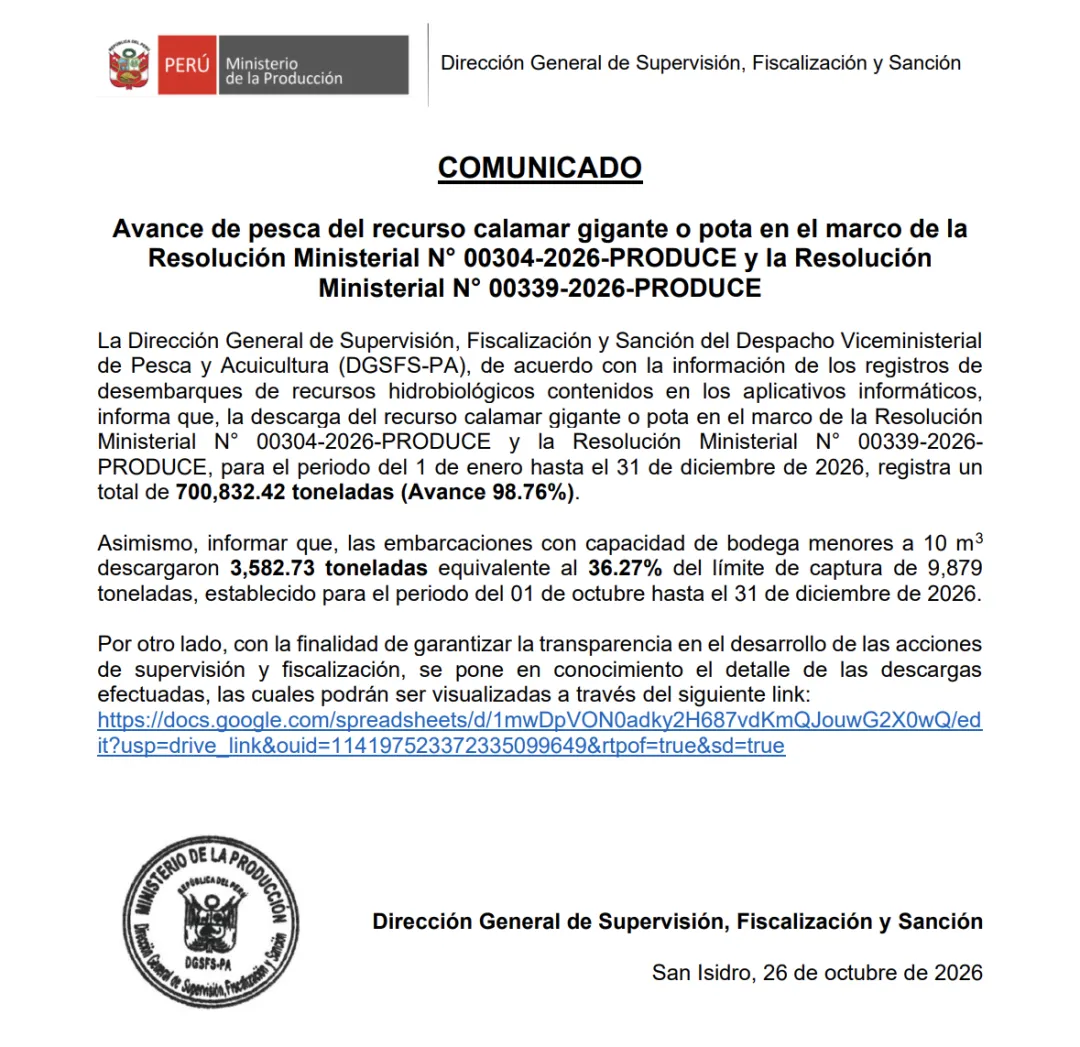
According to data released by the General Directorate of Supervision, Inspection and Sanctions (DGSFS-PA) under Peru's Ministry of Production, cumulative landings of jumbo flying squid (Dosidicus gigas) in Peru reached 700,832.42 tonnes as of October 26, completing 98.76% of the full-year 2026 quota. Compared with data released on October 19, landings increased by 698.15 tonnes over the past week, a rebound from the previous week.
The data show that under the phased fishing arrangement for October 1 to December 31, 2026, vessels with hold capacity of less than 10 cubic meters have landed a cumulative 3,582.73 tonnes, accounting for 36.27% of the phase's fishing quota (9,879 tonnes).
Affected by abnormal sea temperatures triggered by El Niño, the marine environment and the distribution of jumbo flying squid resources off the Peruvian coast have changed, fishing conditions in traditional operating areas have become more complex, and the match between squid stock distribution and conventional fishing grounds has declined, further increasing the difficulty for vessels to locate resources and organize fishing operations.
In the Piura region, many small vessels have suspended jumbo flying squid fishing. Local coastal squid resources have declined sharply, while the cost of traveling to southern waters to find squid stocks has risen, creating a risk of losses. Fishermen's representatives have petitioned the Ministry of Production, hoping that no new restrictions will be added to fishing activities in the final two months of this year; at the same time, they have requested that artisanal fishing be included in the special El Niño assistance program.
02. Argentina's Squid Exports Contract Markedly in Jan-Sep
According to a report compiled by the Argentine Chamber of Shipowners and Freezer Vessel Owners (CAPECA), Argentina's total fishery exports reached 454,200 tonnes in January-September 2026, valued at US$1.866 billion, up 17.8% year on year. The growth was mainly due to the prolonged suspension of the freezer fleet last year.
Squid remained Argentina's single highest-value fishery export product, accounting for 26% of the sector's total export value. In January-September 2026, Argentina's squid exports totaled 174,175 tonnes, down 8.2% year on year, with export value of US$485.3 million, down 9.8% year on year. This year's decline in squid exports stemmed mainly from a shortened fishing season. Reduced fishing operation time limited available supply for export, driving a year-on-year contraction in cumulative export volume.
On prices, the average squid export price was US$2,786 per tonne, down 1.7% year on year. China remained the largest export market, importing 127,971 tonnes worth US$346.8 million at an average price of US$2,710 per tonne. Export value to China rose 5% compared with 2025, with the Chinese market contributing about 70% of Argentina's squid export value, further highlighting its important position in trade of this product.
Other major markets showed mixed performance. Thailand's imports fell to 7,984 tonnes, down 54% year on year; Spain imported 6,721 tonnes, down 26% year on year, but its average purchase price reached US$3,836 per tonne, the highest among major importing markets. Imports by South Korea and Japan fell 35% and 45%, respectively.
Meanwhile, some markets showed new changes. Singapore became a new export destination, importing 6,168 tonnes at an average price of US$2,623 per tonne; Canada's imports rose 126% year on year to 3,087 tonnes. Overall, Asian markets accounted for 87% of Argentina's squid export value and remain the core sales region for this category.
It is worth noting that squid export prices have shown signs of weakening in recent months. The average price fell 8% year on year in August and 4.7% in September. The consecutive declines signal a weakening trend in squid export prices, and further tracking of fishing season progress, export supply and demand changes in major purchasing countries will be needed..
03. Chile's Giant Squid Fishing Industry Calls for Stricter Port Access Management for Foreign Fishing Vessels
Chile's jumbo flying squid (Dosidicus gigas) fishing industry is calling on the government to introduce strong measures to modernize the port access regulatory system, strictly control the entry of foreign fishing vessels into ports, safeguard the sustainable use of marine fishery resources, and address the challenges posed by distant-water fishing fleets in international waters.
Recently, a special forum was held in Tongoy, a coastal town in Chile's Coquimbo Region, where artisanal fishermen engaged in jumbo flying squid fishing gathered to discuss the impact of distant-water fleets on local fisheries. The forum was organized under the leadership of Pascual Aguilera, president of the Federation of Maritime Workers (FETRAMAR) and spokesperson for the National Jumbo Flying Squid Coordinating Committee.
After hearing reports and reviewing relevant data, artisanal fishery representatives at the meeting reached a consensus, calling on the Chilean government to comprehensively upgrade the port access management system for foreign fishing vessels and tighten regulation. Participants noted that when distant-water fleets operate in waters around Chile, existing resource monitoring and management tools are unable to effectively cover them, which could not only impact local fishery resources but also bring socioeconomic risks and resource- and ecology-related uncertainties to coastal communities that depend on jumbo flying squid for their livelihoods.
Aguilera, head of the Federation of Maritime Workers, said the forum was of great significance to the artisanal fishing community. The event helped frontline fishermen and vessel owners deepen their technical understanding of the relevant issues and provided a platform for expressing demands and exchanging views; it also clarified the industry's demands: urging the Chilean government to state its position clearly in multilateral mechanisms such as the South Pacific Regional Fisheries Management Organisation (SPRFMO) and to participate deeply in regional fisheries governance.
Original source: https://mp.weixin.qq.com/s/mLtJSGphRHqcdcMXa8ludA